By Fr. John Parker
Published in Touchstone Magazine in May 2007 and online at
http://touchstonemag.com/archives/article.php?id=20-04-014-v
John Parker on the Dishonesty of Inclusive Prayers
Once I accepted an invitation to give the benediction at the graduation of the Medical University of South Carolina. I was delighted that a school like MUSC was still willing to invoke the Name of God and ask his blessings on those who are to be sent out into the world to practice the work that the school has trained them to do.
Having driven past the university’s beautiful St. Luke’s Chapel (named after St. Luke, the evangelist and physician) hundreds of times, I began to consider what words might be fitting for these medical students. I sat at my desk, reviewing ancient books of Christian prayers, to write the most appropriate one for those commencing the next step of their professional medical lives.
Parochial Names
Two days later, I received by mail a delightful letter, thanking me for agreeing to deliver the benediction and inviting me to a number of related festivities. Included with the letter, though, was a memorandum from the Office of the President of the Medical University: “Guidelines for Invocation and Benediction at Public Functions,” guidelines to which I would be required to conform in order to bless the graduates.
The first was a reasonable request for any public speaker: “Appeal to the larger spiritual virtues that all faiths have in common: love, faith, hope . . . peace, goodness.” The second was acceptable, although dripping with political correctness: “Use inclusive language: forbears rather than fathers, . . .” etc.
The third was a problem. Here is the text (the boldface appears in the original):
Steer clear of parochial, exclusively defining religious names, concepts, practices, and metaphors. A good rule of thumb to remember is that you come representing the entire faith community, not just your own group. The prayer should therefore not be offensive to anyone, whether Catholic, Baptist, Jewish, Muslim, etc. For example, when opening or closing, an inclusive choice would be “Holy God, Holy One, Creator, Sustainer,” rather than “Allah, Jesus, Holy Trinity,” etc.
In four sentences, the Medical University of South Carolina, in its effort to “set a tone of reverence at our public assemblies” and “bear testimony to [our] richly diverse religious and cultural heritage” and somehow to make generic and inoffensive any public benediction or invocation, sanctioned officially one religion over all others: American pop-religion—a tray full of cafeteria-style faith, which takes nice-sounding “religious” words from this group and that, pleasing to the ear but without real content.
I sent my prepared benediction to the Office of the President, wanting to embarrass neither myself nor the staff of the Medical University at graduation. I soon received a polite call from the same office, during which I was un-invited to bless the graduates.
The truly Christian benediction (the only type of benediction I am authorized by my archbishop and my ordination to give) is not permitted. Thus, the university, hoping to display its “religious heritage” and seeking to demonstrate its “pride in . . . diversity,” actually shows itself to be selectively inclusive. Inclusion in the Medical University’s public religious expression is limited to those who will show no conviction at all.
No Good Word
The heritage of the Medical University is, to some degree, Christian. Its chapel is not “generic” by any stretch—it is named for a Christian saint, adorned with his stained-glass image, and topped with the Cross of Christ. These have been the marks of a certain faith. Not a generic faith.
Only a certain faith offers what people truly want and need, while a generic faith cannot—which we often see, ironically enough, in the world into which these graduates are being sent. Someone suffering from a third heart attack doesn’t want to hear about spirits that sustain us or a “god” who is with us in our suffering. He wants—even needs and expects—the blessing and grace of God in that moment.
His heart longs for some assurance that even if his body won’t be okay (sometimes it won’t), Someone is reminding him, “Lo, I am with you always, even unto the end of the age.” This is the very same assurance and grace this Orthodox priest hoped—and was invited—to offer to the graduates who will care for such a soul.
To require a Christian priest to say little more at a benediction than “the Sustainer bids you to peacefully love your neighbor” or “May the Holy One be with you always” is effectively the same as asking a surgeon to say to a man dying on the operating table, “Don’t worry, everything is all right.” It is not a truthful word, and the dying man (and we are all dying men) needs the truthful word.
Doctors, nurses, indeed all hospital personnel and those for whom they care need, like all the rest of us who are struggling to live in this dying world, a true, good word—a real benediction in the fullest sense of the term. Why can we no longer give it to them?
Within the walls of a hospital, a sterile, antiseptic environment is critical for the care and recovery of patients. But the sterile, antiseptic “benediction” the guidelines require is a “good word” to no one, blesses no one, offers no promise of divine aid and comfort to men and women who will need it desperately. Such selective inclusivity removes every particular faith to a space well off to the side, where it can do no harm to the secular ideal of “inclusivity,” but can do no good either.
In the end, to ask a Christian pastor to bless a gathering in this way is little more than having some person in religious clothing stand in front of a crowd to say a few generically religious words, hoping to give some religious legitimacy to a public gathering. Not only is there no power or grace in it, it is devoid of any essential meaning.
A True Prayer
That May, I did offer my prayer for the graduates of the Medical University of South Carolina, though not in their presence. I prayed:
“O Lord Jesus Christ our God, Lover of Mankind, Physician of our souls and bodies, who in pain bore our infirmities, and by whose wounds we are healed:
“Who gave sight to the man born blind, who straightened the woman who was bent over for eighteen years, who gave speech and sight to the mute demoniac, who not only forgave the paralytic his sins, but healed him to walk, who restored the withered hand of a troubled man, who stopped the flow of blood of her who bled for twelve years, who raised Jairus’s daughter to life, who brought the four-days-dead Lazarus to life, and who heals every infirmity under the sun,
“Do now, O Lord, give your grace to all those here gathered who have labored and studied hour upon hour, to go into all the world, and also to heal by the talent you have given to each of them. Strengthen them, by your strength, to fear no evil or disease; enlighten them to do no evil by the works of their hands, and preserve them and those they serve in peace.
“For you are our God, and we know no other. And to you we send up glory together with your Father who is from everlasting, and your most Holy, Good, and Life-creating Spirit, now and ever, and unto ages of ages. Amen.”
John Parker is priest-in-charge of Holy Ascension Orthodox Church, a mission parish of the Orthodox Church in America, in Mt. Pleasant, South Carolina. He earned his MDiv (2001) at Trinity Episcopal School for Ministry in Ambridge, Pennsylvania, and his MTh (2004) at St. Vladimir’s Orthodox Theological Seminary in Crestwood, New York. He can be reached at frjohn@ocacharleston.org.
Copyright © 2007 the Fellowship of St. James. All rights reserved.
Monday, April 30, 2007


Monday, April 09, 2007
O Hell, Where is thy Victory? O Death, where is thy sting?
By Fr. John Parker
Published as "Easter Seen as Victory over Death" in the Post and Courier, Pascha 2007
http://www.charleston.net/assets/webPages/departmental/news/default_pf.aspx?NEWSID=137843
We stood for days by his bed, a small offering by comparison to that of his wife Sarah (names are changed), who barely left his side in the last four years. Timothy had struggled with Alzheimer’s for some time, but following his most recent bout with pneumonia, there was “nothing further the doctors could do”. Though ravaged by a deteriorating mind in the last several years, Timothy lived a full life. His children drove great distances to be with him—a son from Atlanta, a daughter who raced from York, Pennsylvania.
We encircled Timothy in his room at the beautiful new Hospice of Charleston, just up from the Port off Long Point Road. We prayed. We cried. We laughed. We commended Timothy to his Maker, our Lord Jesus Christ. Our Orthodox ritual included long and beautiful hymns, as well as an anointing with holy oil—in this case, myrrh which had been wept miraculous by the eyes of St. Nicholas in an icon from Michigan. The heavenly fragrance filled the air.
To some, this is absolute madness. A vain effort to console ourselves and the one who is dying. What silly humans do when “the doctors can do no more”. Prayers uttered into the deaf ears of the air. The oil has no beauty, no power—just superstition. A ritual whose end it to make sense of a senseless existence and a more meaningless departure. Voodoo.
One could come to such a conclusion if facing death only through the lens of science. Chemistry in the brain affects the body. The heart stops working. Oxygen depletion then shuts down organs. Breathing ceases. Life ends. Words don’t change science; oil doesn’t add oxygen to the brain.
But Christians do not view life strictly this way. It is impossible! Life is so much more than biology. Of course, there is the science of it all. But what of beauty, love, tears, fear, and joy? And Timothy, like all of us, is a human being with a name. He is a unique, unrepeatable individual. He was married. Had Children. And Timothy’s life—and death (as slow and agonizing as it was)—make sense precisely for one reason, and one reason alone: Because God became man, died to conquer death, and He is Risen! Truly He is Risen! In time and space.
Jesus Christ lived and died as God-made-man. His life and work, his death and resurrection, are documented by Jew and Gentile alike—believer and unbeliever. After his brutal crucifixion and death at our hands, after his tomb was sealed and guarded by an extra regiment of soldiers—to be *sure* that no one would steal his body and then *claim* he was raised from the dead—He did this very thing. He conquered death and was raised from the dead, appearing to countless scores of people, beginning with his closest friends and disciples—who then went out to announce joyfully, if not with bewilderment, “Christ is Risen!”
We prayed at Timothy’s bedside precisely in light of this great gift to humankind by God Himself—the conquering of death by his death. The prayers prayed at Timothy’s funeral were prayed precisely because it is what we pray on Holy Friday as Jesus hung on the cross and died, fulfilling the law. “Tetelestai”—“it is finished”, “it is accomplished”, “it is fulfilled.” A portion of the hymns sung at Timothy’s funeral were sung precisely because they are sung for our Lord on Holy Saturday, when, fulfilling the story of the Three Holy Youths (Daniel 3) Jesus descended to the dead, and raised those bound by death, breaking their chains and releasing them from ‘fire eternal’. The whole context of Timothy’s funeral—and every Orthodox Christian funeral—is the Resurrection. No, there’s no superstition here—just the celebration of an eternal and timeless victory. A victory won within time and space by the Creator of all who condescended to become created; a victory the effects of which ripple both forwards and backward in time.
Words from the greatest homily ever preached on Pascha (proclaimed by St. John Chrysostom, the 4th century Patriarch of Constantinople) echo still in our ears reminding us of this great wonder, this great miracle, this great gift:
“Let no one fear death, for the Death of our Savior has set us free. He has destroyed it by enduring it. He destroyed Hades when He descended into it. He put it into an uproar even as it tasted of His flesh.
Isaiah foretold this when he said, "You, O Hell, have been troubled by encountering Him below." Hell was in an uproar because it was done away with. It was in an uproar because it is mocked. It was in an uproar, for it is destroyed. It is in an uproar, for it is annihilated. It is in an uproar, for it is now made captive.
Hell took a body, and discovered God. It took earth, and encountered Heaven. It took what it saw, and was overcome by what it did not see. O death, where is thy sting? O Hades, where is thy victory? Christ is risen, and you, O death, are annihilated! Christ is Risen, and the evil ones are cast down! Christ is risen, and the angels rejoice! Christ is risen, and life is liberated! Christ is risen, and the tomb is emptied of its dead; for Christ having risen from the dead, is become the first-fruits of those who have fallen asleep. To Him be Glory and Dominion unto ages of ages. Amen!”
For this we gathered to pray for Timothy in his death. For this reason, our sadness is joyful—for death has not had the final word. For this we have hope, not in vain, since God Himself was dead but is risen. Christ is Risen! Truly He is Risen!
Fr. John Parker is Priest-in-charge of Holy Ascension Orthodox Church in I’On. He can be reached at 843.881-5010 or at frjohn@ocacharleston.org.
Monday, April 02, 2007
Extreme Humility is the Path to Salvation
 Published in the Post and Courier on 3.25.2007 as Extreme humility path to salvation
By Fr John Parker
His appearance: peaceful, serene. Jesus Christ stands in his tomb, in front of the cross, already having been crucified. His hands are crossed, as if bound, but there is no rope holding them together (His self-offering is voluntary). His eyes are closed. Other implements of the crucifixion are evident: the sponge by which he was offered wine-vinegar to drink when he cried out, “I thirst”; the spear which pierced his side, releasing both blood and water, showing him to be truly dead on the cross.
Crucified. Silent. Entombed. This is “extreme humility.”
In His last hours, our Lord Jesus Christ showed this extreme humility in many ways, mostly, though, by his silence. His wordlessness was a silent echo of the prophecy of Isaiah, “As a sheep led to the slaughter, or a spotless lamb before its shearers is dumb, so he opened not his mouth…” Our Lord accepted His brutal scourging, crucifixion and death, in almost total silence, with unwavering faith and confidence in the love and will of his Father.
His actions on the Cross, like the example of every moment of his life, were a living out of the very Gospel he incarnated, made flesh. If someone asks you to walk one mile, walk two. If someone slaps you on one cheek, offer them the other. If someone takes your cloak, give him your robe as well. All of this recorded, of course in the Gospel accounts of the Passion of Christ. The arduous journey to Golgotha; the offering not just of the other cheek, but of his whole body for beating—and not just for beating, but for death; the stripping of his garments and the lots cast for them. This is extreme humility.
This is the royal road to salvation. By the power of the precious and life-giving Cross—through the death and resurrection of Jesus Christ—we are invited onto this holy path, the way to healing, wholeness, salvation.
Extreme humility takes many forms which all have similar characteristics. One is drawing little attention to one’s own self and accomplishments while giving credit to God alone for whatever good we appear to have done. God alone is good, and to quote St. Basil the Great’s liturgy from the fourth century “we have done nothing good upon the earth.”
Another is constant self-denial, which even includes denying special ‘spiritual gifts’—visions, tongues, dreams, prophecies, etc—which seem to come from God himself. Why? Because the Christian leading the life of extreme humility, witnessed in the lives of countless saints through the ages, stands with—and perhaps, dare I say, in front of St. Paul—claiming to be the chief of sinners (“The saying is sure and worthy of full acceptance, that Christ Jesus came into the world to save sinners. And I am the foremost [literally ‘first’] of sinners” 1 Timothy 1:15.) True humility says, “I am worthy of neither visions nor tongues, nor dreams, nor prophecies. Surely the Lord would choose to give such gifts to others much more faithful than I.” The saints teach, in fact, that it is better to seek the fruit of the Spirit (love, joy, peace, patience, kindness, goodness, gentleness) than the gifts of the Spirit, since the former contribute to humility and holiness, while the latter often leads to spiritual pride, the most dangerous of sins. In short, if someone sets up a sign that says, “I’m a healer!” or “I am a prophet!” beware; the true saint not only wouldn’t announce it, he or she would likely deny it if asked.
The royal road to salvation is this: deny thyself, take up thy cross, and follow me (says Jesus Christ). The self denial is not for its own purpose, but rather to take up solely the will of the God who is Love. The Cross is not my own, but joining my burdens, trials, and struggles to the Cross of Christ, which has trampled down death and sin, and has broken the chains which bind us. And to follow Christ in the fullest sense, is to stand, even in the face of the gravest persecutions and tortures, in silence, trusting in the might and mercy and righteousness of God, in extreme humility.
Fr. John Parker is the priest-in-charge of Holy Ascension Orthodox Church in I’On. He can be reached at frjohn@ocacharleston.org or by phone at 843.881.5010.
On the Paralytic
Homily on Mark 2:1-12
By Fr. John Parker
Today I proclaim to you the joyous news of two Prosphora—two gifts, two offerings. The first is a paralytic, lifted up. A man so paralyzed that, according to St. Mark’s accounting, he does not or cannot even offer his own faith. According to the Scriptures, four men came to Jesus (pherontes pros avton paralutikon) bearing up, offering up, gifting Him a paralytic. Borne up by the four, unable to approach directly because of the crowd, the paralytic is lowered into the presence of our Lord Jesus Christ. It is in the presence of the Word, and by His word, and through the faith of the four friends that the paralytic’s sins are forgiven, that the broken man is made whole, raised up, and that the man goes out—goes home, to show by his walking and skipping and jumping that Jesus Christ is the One who is, and who was, and who is to come.
This is the first prosphora, the first offering, the first gift.
The second prosphora, the second offering, the second gift, is also a broken man. And yet, not only a man, but God-made-man. It is our Lord Jesus Christ, also lifted up, and because of the crowd. Not causally in the sense that there were too many people, but causally in that we, the crowe, shouted out for Him to be lifted up: Crucify Him, Crucify Him! Raised up not onto a rooftop, but onto the cross. Broken not by sin, but by us sinners, and so providentially, for us sinners.
And once raised up, broken, dead, also lowered. Not only lowered from the tree, dead, but also descending Himself, as God, into another crowd: the Dead. And there, not for the forgiveness of His sins (He was and is sinless), not for His healing (He is the Great physician of our souls and bodies, indeed the healer of the paralytic), but for the forgiveness of our sins, for the healing and salvation of us who crucified Him in the first place.
And this One, also not left in the midst of the crowd, unable to move or help Himself; this one also raised up, on the third day. Raised from the dead; Resurrected. Trampling down death by death. And this one also showing Himself to many—many of whom, like the first man’s friends, glorified God (amazed), saying, “We never saw anything like this!” (Though some doubted.)
And it is this prosphora, this offering, this Man, Jesus Christ, whose Gospel is up borne likewise by four men, four pillars, whose names we know: the Evangelists—Matthew, Mark, Luke, and John.
It is by their testimony that we know these two prosphora, these to gifts, these two offerings. The first a shadow of the second, the paralytic fortelling and proclaiming the Lord Jesus Christ.
Let us paralytics also, broken and helpless, call on the Lord who is quick to save. And though we cannot lift ourselves, we can lift up those around us, by faith, with the sure hope of the Gospel, knowing the Almighty and Merciful God. And let us, like the four Evangelists, recount the Gospel of Jesus Christ to the world, not with parchment and pen, but with the love of God written by our deeds every moment of our lives. Amen.
Repentance is the Royal Path to Life
Published in the Post and Courier on 2/25/07, there entitled: Repentance a renewal, not doom and gloom
By Fr. John Parker
The vast majority of Christians on our planet began, this past week, to celebrate Lent, also known as the Great Fast in the Orthodox Christian tradition. The Fast owes its existence, in part, to the 40 days in which Jesus went into the desert to be tempted by the devil following His baptism by St. John the Forerunner. The Great Fast is, for us in the world, our annual pilgrimage to the inner desert, wherein we seek to join ourselves most fully to God by prayer, fasting, and almsgiving, in anticipation of the crucifixion and resurrection of Jesus Christ. Here we struggle to learn and to live: “Man does not live by bread alone, but by every word that proceeds from the mouth of God.” “You shall not tempt the Lord your God.” And, “you shall worship the Lord your God and him only shall you serve.”
This voluntary sojourn in the inner-desert is book-ended in Matthew’s Gospel by a command given on the one end by St. John the Baptist (3:2), and on the other, echoed by our Lord Jesus Christ (4:17), “Repent for the kingdom of heaven is at hand.” By “the kingdom of heaven is at hand” Jesus indicates that He himself is inaugurating the re-creation of the world. His life, death, resurrection, and ascension are as God incarnate who has come to save the world. And by ‘world’, He does not mean just “people”. The Holy Scriptures teach that “God so loved the world that he gave his only-begotten Son…”. He so loved the ‘cosmos’, as it says in Greek. God’s renewal of the fallen cosmos is now underway, and will be completed, we believe, with Jesus’ second coming to judge the world.
But what does it mean, “Repent?” The word itself strikes fear in the hearts of some, occasionally brow-beaten by self-appointed prophets of doom who announce, “Turn or burn!” by their placards and angry voices. For many others, “repent” is some old-fashioned concept rooted in a time from which we have now been liberated—a time when somebody besides myself had the authority to tell me what is right and wrong—mostly what is wrong. In this view, repentance is what fools do who don’t yet understand that what’s right in my eyes is right for me, and what is right for you is right for you.
Neither of these is Christian, so what does a Christian understand when he reads “Repent!”? Repent means this: change your mind. Change your heart. Change your direction. But this change presumes that there is a revealed standard. There is a ‘right mind’; there is a ‘right heart’; there is a ‘right direction’. We are not turning around for the sake of going in another, random direction. We do not change our hearts to match that of some Hollywood star. We do not change our mind in order simply to have a new perspective—in order to get out of a rut.
When a Christian observes what we call daily life, we don’t see life—we see remnants of life, and a lot of death. We know what life is because God has revealed what life is—or more precisely, because in Jesus Christ, God has revealed himself as life. Through the lens of Jesus, we see ourselves as seriously lacking, and only remotely human. We recognize our need to turn back to Him.
The beauty of it all, though, is that because of God’s love and mercy for the whole cosmos, death does not reign permanently. Jesus has conquered sin and death, and we can make this return to Him. In fact, it is He Himself who calls us home—to change our minds, hearts, and directions. To return to the narrow, straight path. To return to chastity, humility, patience, and love, not as defined by the world, but as revealed in Christ. To return to God.
Repentance is not a threat (or else!), it is a gift. It is the return flight of what we thought was a one-way ticket to destruction and death. Repentance is not out-moded and old-fashioned. Rather, it is a moment-by-moment renewal, and in fact, it is evidence of the truly open mind, especially when one recognizes that his own is not right.
Orthodox Christians exhort one another to “enter the Fast with joy”. Repent with joy? Yes! And we can do so precisely because we understand that repentance brings healing and union with God, and not a judicial acquittal from an angry judge on the last day. Repentance is God’s grace returning life to a dying world. Repent! For the kingdom of heaven is at hand.
Fr. John Parker is priest-in-charge of Holy Ascension Orthodox Church on the Square in I’On. He can be reached at frjohn@ocacharleston.org or by phone at 843-881-5010.
Faith of our Fathers: A Colloquium on Orthodoxy for Anglicans
By Fr. John Parker
Published in the Post and Courier, Sunday, February 4, 2007
Nineteen degrees and snowing. An ecumenical affair: Orthodox Christians addressing curious Anglicans and Episcopalians in a Roman Catholic retreat center which shares a parking lot with an Orthodox Monastery of Romanian and American monks. Inside the retreat, a bustle of 50 or so attendees who traveled to Detroit from warmer climes, Florida included. Others from South Carolina, Maryland, and Illinois. A few came to warm up in Detroit, having crossed their southern border from Toronto. The most amazing of the attendees, in my opinion, was a former Episcopal priest—a woman—who has come to understand the way of the Ancient Church and renounced her ordination in order to enter the Orthodox faith.
On Monday and Tuesday, January 29-30, I had the privilege of taking part in this fascinating conference. “Faith of our Fathers: a Colloquium on Orthodoxy for Anglicans” was organized with the blessing and encouragement of His Eminence, the Most Reverend Nathaniel, Archbishop of Detroit and the Romanian Episcopate of the Orthodox Church in America.
Archbishop Nathaniel had been approached by several local Episcopalians and neighboring Canadian Anglicans who asked, “How can you help us?” a question rooted in both the recent and centuries-old scandals and struggles which are plaguing the Anglican Communion worldwide.
His Eminence made it very clear in his keynote address on Monday that the conference was not intended or organized in any way to solicit Episcopalians to the Orthodox Church, but rather was an answer to a profound request for guidance and assistance. The Archbishop’s biblical foundation for the conference, he elaborated, was the Parable of the Good Samaritan. He noted that the traveler did not cry out for help, but rather lay beaten on the roadside. It was the Samaritan who took note of the bloodied man, had compassion on him, and made arrangements for his recovery.
The conference was structured around four basic lectures: “Theology”, “Liturgy”, “Culture and Tradition”, and “Practical Considerations”. Each was preceded by a brief account of a personal journey to Orthodoxy. The speakers were predominantly former Episcopalians, most of them now Orthodox Priests. The lineup included Charleston native, Fr. Gregory Mathewes-Green (who—along with the present Dean of the Episcopal Cathedral of St. Luke and St. Paul, the Very Rev. William McKeachie—coauthored the Baltimore Declaration); his wife Frederica, also a native Charlestonian and well-known columnist, speaker, and author of books like Facing East and The Illumined Heart; Fr. Patrick Henry Reardon—one time professor at Trinity Episcopal School for Ministry, and present lecturer at Nashotah House Seminary; and others.
His Grace, the Rt. Rev. Mark, Bishop of Toledo and the Midwest of the Antiochian Orthodox Archdiocese of North America, shared with the conference participants his engaging arrival to the Orthodox Church. Bishop Mark found his way from his native Roman Catholicism to charismatic Christianity, finally studying at and then teaching at Oral Roberts University. His ever-deepening studies of the Old Testament, along with engaging conversations with an Orthodox professor at ORU led him to embrace the Ancient Church, in which he now serves as a hierarch.
A third bishop, His Grace, the Rt. Rev. Tikhon, Bishop of Philadelphia and Eastern Pennsylvania of the Orthodox Church in America, shared briefly about how is life is “made very interesting” by the fact that his mother serves as an Episcopal priest.
I believe it is safe to say that very few of the conference attendees came to hear about the Orthodox Church and faith for the first time. Many appeared to know a significant amount already, and have developed friendships with Orthodox clergy and lay people in their respective hometowns. There were, however, a few difficult questions, which required a delicate response—though the answers remain unchanging.
One fellow from Canada asked, for example, why the Orthodox Church practices what many call “closed communion”, allowing only those members of the Orthodox Church to receive communion in their services. Several speakers explained this commonly misunderstood and challenging pastoral matter. In fact, in the Orthodox Church, not even all Orthodox can/ought to receive communion at any given service. Our discipline is to serve those who have prepared themselves by prayer, fasting, and recent confession, taking very seriously St. Paul’s exhortation to the Church in Corinth (1 Cor. 11:27ff).
The grounds for so-called “closed communion” are ancient and simple. First (also a practice abandoned by many non-Orthodox Christians today), one must be baptized to receive. Baptism is open to all repentant sinners, in the Christian view, and is the doorway into the life of the Church. Second, the Church has always believed that Communion is the sign of the shared fullness of faith, and not the maker of it. In other words, it makes no sense for a group of people to “have communion together” who don’t believe the same things about who Jesus is, why he lived and died, how we are called—voluntarily—to change for and be changed by God, and what the bread and wine become in the liturgy. In short, in this scenario, there is no “common union” (the meaning of “communion”) except the action of eating and drinking something together at the same time.
The inquirer was also somewhat surprised to hear that this was the universal practice and belief of all Christians for 1500+ years, and for Anglicans until the 1950s or 1960s. It has always been and remains the practice in the Orthodox Church (as well as the Roman Catholic Church, I believe) to this day.
“Faith of our Fathers” was a conference rooted, at least generally speaking, in Acts 2:42. We shared the teachings of the Apostles, we sat at table together, we enjoyed one another’s company in fellowship, and sang a beautiful Vespers (evening prayer) service on the occasion of the Feast of the Three Holy Hierarchs: St. Basil the Great, St. Gregory the Theologian, and St. John Chrysostom, fourth-century luminaries universally remembered for their essential contributions to Christian theology and preaching.
The talks from this conference will all be available for download at http://www.ancientfaithradio.org/, a 24-hour Orthodox internet Radio station.
Fr. John Parker is priest-in-charge of Holy Ascension Orthodox Church located on the Square in I’On. He can be reached at frjohn@ocacharleston.org or by phone at 881-5010.
Sunday, December 24, 2006
Christ is Born! Glorify Him!
Published in the Post and Courier on 12.24.06 originally as The Nativity has two focuses
Christ is Born! Glorify Him!
(Part IV of IV)
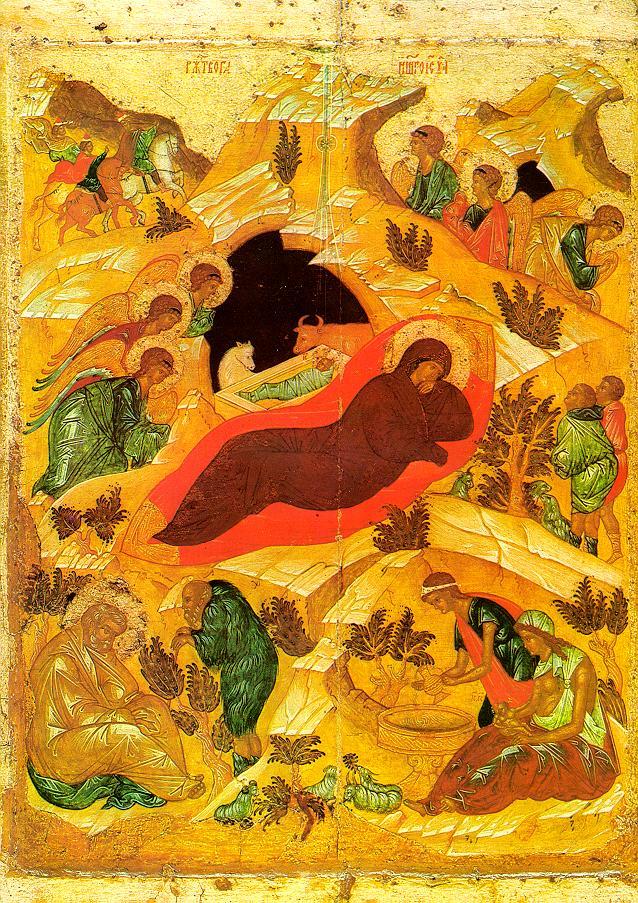
Our journey to Bethlehem through the images in St. Andrei Rublev’s Nativity finishes at the center—a center which has two foci: Mary, the Virgin Mother, and the somewhat less obvious (because of his size) newborn Christ (who, biblically speaking, is not “Jesus” until he is named on the 8th day—see Luke 2:21.)
Mary—the Theotokos, or God-bearer, as she is known in the Church—is the most noticeable figure in the icon. One’s eyes are immediately drawn to her, not only by her central location, but by her relative size and the bright red color of the bed on which she lays. The ever-virgin Mother’s body faces our Lord, yet her eyes gaze into the distance, as she keeps all that which the Shepherds told her, “pondering them in her heart” (Luke 2:19). Mary’s geometrically central position in this icon points to the reality that she herself is the gift which we human beings offer for this redemptive event. Recall the hymn we’ve been singing:
What shall we offer Thee, O Christ, Who for our sakes hast appeared on earth as man? Every creature made by Thee offers Thee thanks, The angels offer a hymn; The heavens a star; The wisemen gifts; the shepherds, their wonder; The earth, its cave; the wilderness, a manger. And we offer Thee a virgin mother. O pre-eternal God, have mercy on us!
“We offer Thee a virgin mother…” Mary is the pure offering of humanity, known in the Church by many of the names given to the instruments of worship in the Old Testament, and supremely, “the Temple” itself—Her womb being the actual dwelling place of God-made-man. The Theotokos is not for us the great exception, but rather, the great example. She was chosen and prepared by God, and by her consent—her ‘fiat’, bore Emmanuel, God-with-us.
The Church chants this beautiful hymn as from the lips of the Mother of God:
‘Thou, O my Son, art the all-perfect God, Yet Thou didst accept the form of Adam! In my hands I hold Thee, yet Thou dost hold all creation! How shall I wrap Thee in swaddling clothes? How shall I nourish Thee, O Food of Life? How shall I wonder at Thine ineffable poverty? How shall I name Thee, since I am Thy servant?’ Thy mother cried: ‘I can only sing and bless Thee, For Thou dost grant the world great mercy!
Indeed, as evidenced here at the Nativity, Mary is the first and most important Christian, as described in a beautiful hymn we sing of her. She is “more honorable than the Cherubim, more glorious beyond compare than the Seraphim.” As we contemplate the Nativity of Christ, we can hardly overlook her who gave birth to God the Word. We are obliged by gratitude and joy to fulfill her prophetic hymn, “all generations shall call me blessed.” Indeed, “Blessed are you among women and blessed is the fruit of your womb, for you have borne the Savior of our souls!”
Now, in the silence of the black cave, at the tips of the noses of the curious ox and ass (who recognized their maker), and resting gently no longer in, but just outside the womb of his most-pure mother, we find our Lord, according to the Scriptures, wrapped in swaddling clothes and lying in a manger. What are these swaddling clothes? Much more than just some rags that happened to be at hand! Those familiar with the icon of the raising of Lazarus from the dead will recognize that the infant Christ is wrapped, more specifically, in a burial shroud. Even in his nativity, hinted at also with the gift of myrrh, the purpose for his incarnation is made manifest: born to die for the sins of the whole world.
In the icon, as in life, our Lord is ‘findable’ but must be sought out. Have I looked? Have I found the One whom the angels today hymn? Have I found the One, worshiped by the Magi who learned of Him from the stars? If we don’t know where to look by ourselves, we can follow the star, the magi, the shepherds, the animals. They all know where to point us. “Seek and you shall find.”
Once having found and recognized Him as the Prince of Peace, Mighty God, Holy One, Emmanuel, have I asked the resounding question, “What shall I offer Thee, O Christ, who hast appeared on Earth as Man?” What can we offer him besides true worship and obedience? “And the Word was made flesh and dwelt among us!”
Especially for Nativity of Christ, Orthodox Christians have a special “call and response” greeting. Beginning this evening, one joy-filled Christian greets another, “Christ is born!” and the other responds, “Glorify Him!” Such a greeting is exchanged during the many days of this feast which commences, not ends, at the Vigil of the Nativity.
With the angels, I greet you, and bring you “good news of a great joy which will come to all the people; for to you is born this day in the city of David a Savior, who is Christ the Lord” (Luke 2:10-11). And with jubilation, I salute you with the blessings of the feast. Christ is Born! Glorify Him!
Fr. John Parker is priest-in-charge of Holy Ascension Orthodox Church in I’On. He can be reached at frjohn@ocacharleston.org or by phone at 843-881-5010.
Monday, December 18, 2006
A Strange Pair draws near to the Newborn Christ (Part III of IV)
By Fr. John Parker
The Angels are rejoicing and proclaiming the Good News. The Magi, journeying from afar, bear their gifts foreshadowing the divinity, sovereignty, and humanity of Christ. The shepherds, the first Jews to believe, explain what they have seen and heard, leading others, too, to wonder!
As we make our way, as if in a spiral towards the center of Rublev’s Nativity, we are greeted by a strange pair. A couple we wouldn’t expect to find so attentively gazing on our Lord. Two that are as close to Christ in proximity as the Virgin Mother.
Two well-known carols in the Western Christian tradition reference these two animals who by their eyes direct ours to our infant Lord in the manger. Perhaps you remember the tunes:
Why lies He in such mean estate / Where ox and ass are feeding? / Good Christian, fear: for sinners here, / The silent Word is pleading. (“What Child is This?”)
Ox and ass before him bow / And He is in the manger now. / Christ is born today! / Christ is born today! (“Good Christian Men, Rejoice!”)
But where do this ox and this ass appear in the Gospel accounts of the Nativity? Every crèche displays them. We sing about them. Christians paint them into the Nativity. And yet searching high and low through the Nativity accounts in Matthew and Luke, we don’t encounter them. Why? Because they are not found in the New Testament! The ox and ass put us humans to shame, according to the prophecy of Isaiah, nearly 800 years before the Holy Advent of our Lord:
“The ox knows its owner, and the ass its master’s crib; but Israel does not know, my people does not understand” (Isaiah 1:3).
The birth of the Messiah, Emmanuel: God with us, Jesus the Christ, is truly an awesome event—in the classical sense of “awesome”. So marvelous is it, so utterly extraordinary—the heavens and the stars recognize Him. The earth itself recognizes him. “Foreigners” recognize him. Even “dumb” animals worship Him! Once again, we return to the Orthodox Christian hymn:
What shall we offer Thee, O Christ, Who for our sakes hast appeared on earth as man? Every creature made by Thee offers Thee thanks, The angels offer a hymn; The heavens a star; The wisemen gifts; the shepherds, their wonder; The earth, its cave; the wilderness, a manger. And we offer Thee a virgin mother. O pre-eternal God, have mercy on us!
In fact, one of the theological reasons we celebrate Christmas at the Winter Solstice (just a few days later on our present calendar…) is because of the point made by the universe at this time. What is that point?
The Solstice is the shortest day of the year. Each day thereafter, light increases on the Earth. “The light shines in the darkness, and the darkness has not overcome it” (John 1:5). The true light, Jesus Christ, has come into the world, and the darkness has not overcome him. For Christians, Christmas is a festival of the Light, Jesus Christ who announced, “I am the light of the world.”
The heavens demonstrate it; the stars point to Him; the ox and the ass gaze upon Him, showing us with their devotion what they cannot tell us with words. And we are left with the question Jesus later asks Peter and his followers, “Who do you say that I am?”
Fr. John Parker is priest-in-charge of Holy Ascension Orthodox Church in I’On. He can be reached at frjohn@ocacharleston.org or by phone at 843-881-5010.
Originally printed in Charleston's Post and Courier on Sunday, December 17, 2006 and online at
http://www.charleston.net/assets/webPages/departmental/news/default_pf.aspx?NEWSID=122794
Tuesday, December 12, 2006
The Journey to Bethlehem Continues (Part II of IV)

The Journey to Bethlehem Continues
(Part II of IV)
What shall we offer Thee, O Christ, Who for our sakes hast appeared on earth as man? Every creature made by Thee offers Thee thanks, The angels offer a hymn; The heavens a star; The wisemen gifts; the shepherds, their wonder; The earth, its cave; the wilderness, a manger. And we offer Thee a virgin mother. O pre-eternal God, have mercy on us!
Last week, we began our “Journey to Bethlehem” through Rublev’s stunning Icon of the Nativity. We encountered St. Joseph, tempted by the devil, as well as the nursemaids giving our Lord his first bath; and we learned of the critical meeting of the divine and the human in Jesus’ birth.
According to the hymn I have shared above, the angels offer a hymn, the heavens a star, the shepherds—their wonder. What hymn do the angels offer? The very hymn sung still today in the Orthodox Churches as the “Small Doxology” in the Matins (morning prayers) services, and known in many Western Christian Churches as “the Gloria”: “Glory to God in the highest, and on earth peace among men, with whom he is pleased.” We introduce this angelic hymn with a theological praise: “Glory to Thee, who hast shown us the light!”
The angels, glowing with the light of Christ, “the glory of the Lord,” also greeted the wondering shepherds. According to the Scriptures, these Jewish shepherds went and found the announced Savior, born as a child, and told all what they had seen and heard from the angels. Not surprisingly, “All who heard it wondered at what the shepherds told them.” What was the wonder? Quite surely the very same wonder uttered by Jesus’ cousin, John the Baptist, “Are you he who is to come, or shall we look for another” (Luke 7:20)? More on the answer to that question when we speak about the ox and the ass who gaze into the manger.
While the shepherds were among the believing Jews, the “three” Magi, or wise men (not numbered in the Scriptures, but know traditionally in the Church as Gaspar, Melchior, and Balthasar), represent the offering of salvation to the “rest of the world”, known biblically as “the Gentiles”. The promise of salvation was not given strictly to the chosen Jews, even seen clearly in God’s words to the Patriarch Abraham: “…I will make of you a great nation, and I will bless you, and make your name great, so that you will be a blessing. I will bless those who bless you, and him who curses you I will curse; and by you all the families of the earth shall be blessed” (Genesis 12:2-3, LXX). How shall Abraham “be a blessing,” and how is it that through him “all the families of the earth shall be blessed?” Because Abraham is the forefather of King David, who is the forefather of Jesus Christ. In Jesus Christ, this promise is fulfilled, and for this reason the star appears, the Angels rejoice, and the shepherds wonder!
These gentile astronomers offered prophetic gifts to the Infant King: gold foretelling his royalty; frankincense (a fragrant incense), his divinity; and myrrh (a fragrant ointment/oil especially used to prepare corpses for burial) foreshadowing his death. Equally as beautiful as their gifts and their representation of the salvation of the gentiles is what they learned from this experience. Consider this Orthodox Hymn of the feast:
Thy Nativity O Christ our God, has shown to the world the light of wisdom / for by it those who worshipped the stars, were taught by a star to adore Thee, the Sun of Righteousness / and to know Thee, the Orient from on High, O Lord, Glory to Thee!
The magi (not magicians or kings, but astronomers) who “worshipped the stars” were “taught by a star” to adore Jesus Christ.
The Lord of Creation and King of Glory uses all that he has created to point each and every one of us, in our own unique way, to know him, Emmanuel, God with us.
Fr. John Parker is priest-in-charge of Holy Ascension Orthodox Church in I’On. He can be reached at frjohn@ocacharleston.org or by phone at 843-881-5010.
Published online as "The Magi followed the Light to Bethlehem" at http://www.charleston.net/assets/webPages/departmental/news/default_pf.aspx?NEWSID=121953
And in the Post and Courier on Sunday, December 10, 2006.
And in the Post and Courier on Sunday, December 10, 2006.
Sunday, December 03, 2006
The Journey to Bethlehem Begins
 By Fr. John Parker
(note: first in a series of four)
About seven hundred years ago, St. Andrei Rublev or one of his disciples painted perhaps the most memorable and beautiful icon of the Nativity of Christ. The 14th century icon is warped and cracked, but is in remarkable shape despite its age and history. It tells us, in earthen pigments bound to the gesso plaster, the story of the birth of Jesus, each facet of the good news surrounding the Virgin Mother Mary and the newborn Emmanuel—“God with us.” It teaches us with paint what we sing in one of the many traditional Orthodox hymns of the Nativity:
What shall we offer Thee, O Christ, Who for our sakes hast appeared on earth as man? Every creature made by Thee offers Thee thanks, The angels offer a hymn; The heavens a star; The wisemen gifts; the shepherds, their wonder; The earth, its cave; the wilderness, a manger. And we offer Thee a virgin mother. O pre-eternal God, have mercy on us!
During this season—as it is most widely known “Advent” (from the Latin, “coming”)—of preparation, please join me on a four Sunday journey around this holy marvel, on a theological pilgrimage to the birth of Jesus Christ.
We’ll start with the two scenes on the bottom. On the left sits an old man with an evident halo (a saint) confronted by a crooked fellow in a dark, hairy coat. St. Joseph, the foster-father of Jesus Christ is being tempted by the Devil to divorce Mary. Joseph is an old man, who, according to the tradition of the Church, was a widower obligated by his relationship to Mary to betroth her and care for her, who had been set apart as a temple virgin to bear the eternal Son of God in the flesh.
According to the Scriptures, “When [Jesus’] mother Mary had been betrothed to Joseph, before they came together she was found to be with child of the Holy Spirit; and her husband Joseph, being a just man and unwilling to put her to shame, resolved to send her away quietly. But as he considered this, behold, an angel of the Lord appeared to him in a dream, saying, ‘Joseph, son of David, do not fear to take Mary your wife, for that which is conceived in her is of the Holy Spirit; she will bear a son, and you shall call his name Jesus, for he will save his people from their sins’” (Matthew 1:18ff).
The temptation was to “send her away quietly” so as to not draw attention to a pregnant, unwedded teenager betrothed to an old man—even though Joseph and Mary never ‘knew’ one another, that is, they never slept together. Joseph may have had good intentions to protect young Mary, but God had other plans for him. He was told by an angel that this pregnancy was, in fact, a miracle and nothing to be ashamed of; rather, it was to be celebrated as the fulfillment of God’s promises, especially through the Prophet Isaiah, to save the world through a son, born of a virgin, in the lineage of King David.
If the images of St. Joseph and the Tempter narrate the miraculous birth of the divine Jesus Christ, the scene in the lower right shows the humanity of the birth of the Son of God. Jesus was not dropped onto the earth by an extraterrestrial ship, nor did he simply ‘appear’ as a created being. Rather, as the beginning of the redemption of all humanity and the whole world, he entered just as every single one of us does: through the womb. The birth of Christ is totally extraordinary in conception—“of the Holy Spirit” as the Angel told Joseph, and yet it is totally ordinary in its accomplishment. And so, here, we see two nursemaids doing what is done at every birth: receiving the newborn child and washing him to present to his mother. O strange wonder: God is made man. Heaven and earth meet. O come, o come Emmanuel!
Today the Virgin gives birth to the transcendent one, and the earth offers a cave to the unapproachable one! Angels with shepherds glorify Him! The wise men journey with the star! Since for our sake the eternal God was born as a little child!
Fr. John Parker is priest-in-charge of Holy Ascension Orthodox Church in I’On. He can be reached at frjohn@ocacharleston.org or by phone at 881-5010.
printed in the Post and Courier, December 3, 2006, and online at http://www.charleston.net/assets/webPages/departmental/news/default_pf.aspx?NEWSID=120991)
Tuesday, November 07, 2006
Salvation has many facets
Salvation: all the facets of a single diamond
By Fr. John Parker+
Author's note: This is the unedited version of my article published in the Post and Courier on SUNDAY, SEPTEMBER 24, 2006 entitled, "For Christians, salvation has many facets"]
When an Orthodox Christian is asked the question, “Are you saved?” we don’t exactly know how to answer. It isn’t that we don’t know Jesus Christ; we’ve known Him from the beginning. It isn’t that we have a lack of understanding about salvation—history and theology books are filled with our teaching on these matters. We don’t know exactly how to answer because it is not a question with which we are familiar. In fact, we would say that the question raises a deeper question: What is salvation?
Consider these scenarios:
A sailor falls overboard into the swirling, stormy sea. His shipmates have their eye on him as they make preparations to recover him. In a shrill voice, muffled by the storm, he cries out to them, “Save me!” If they are not able to get to him in time, he will be regarded “lost at sea”.
A vibrant young tennis star is involved in a terrible car accident which crushes her right arm. Once at the hospital—things are looking grim—she musters a question for the surgeon amidst sobs mixed with pain and fear: “Can you save my arm, Doctor?” If the skilled medic is unable to perform such a medical miracle, she will lose her limb.
A wealthy woman is taken hostage. To spare her life, her captors demand a million dollars for her return. The cash is delivered to the drop site, and the relieved woman is set free.
An evil enemy is striking fear into the hearts of many and wreaking havoc on a certain people. Troops are sent in, the enemy is put down, victory is clear, and life returns to ‘the way it is supposed to be.’
Salvation is rescue, healing, ransom, and victory reflecting equally together [editor, please leave italics] what it is ‘to be saved’. The rescued man is saved. The tennis star’s life is saved. The hostage’s life is saved. The victory in and of itself is a salvation. These are all facets—the carefully fashioned sides—of a single diamond called salvation.
The man overboard is like St. Peter, called to walk to Jesus on the water. The wind and the tumultuous sea around him caused him to take his eyes off of his Lord, and to sink. “Save me!” he cried out, and stretching out his hand to raise him up, Jesus saved him.
The maimed tennis star is like the crippled man who was healed by St. Peter. “’I have no silver and gold, but I give you what I have; in the name of Jesus Christ of Nazareth, walk.’ And he took him by the right hand and raised him up; and immediately his feet and ankles were made strong.” Later, Peter and John were questioned about the means by which this man was saved (most English translations say ‘healed’ but the verb is ‘saved’). The means was a person: Jesus.
The hostage is like any one of us held captive in sin and death. We are bound up, and a ransom is necessary for our release. Jesus paid the ransom, saving us. But we must be very careful! We are not tied up by God, who made us Himself and loves us. Jesus did not pay off His Father by His own death—to assuage the “wrath of a justly angry God”. Nor is the Devil paid. To offer money to him would be to give him power equal to God, and we are not dualists. Rather, the ransom is paid to death itself. Our self-inflicted wound (running away from God) results in death. God died to release us from it. He beat death to save us from its eternal grasp.
The evil enemy in the fourth scenario is death. Death strikes fear into the hearts of men and women. No one is spared physical death, but Orthodox Christians believe that we are saved from the finality of eternal death, singing our belief about Jesus’ victory, “Christ is risen from the dead, trampling down death by death, and upon those in the tombs bestowing life.” St. John Chrysostom said this another way—in his homily which is preached in every Orthodox Church in the world on Pascha (Easter). “Hell took a body, and discovered God. It took earth, and encountered Heaven. It took what it saw, and was overcome by what it did not see…Christ is Risen, and you, o death, are annihilated!”
Salvation is the fullness of life. It is sanity, health, communion with God. It is a return from rock bottom to the sure foundation made of stone. It is a rescue from eternal death. It is a restoration, in fact, of all creation, a renewal of the whole cosmos. Are we, can we be, saved in a particular moment? Surely! But it must be this moment…because this moment is the only one I have. I am not living five minutes ago or five days ago or five years ago. I am living in what some call the eternal now. Salvation, like life, is at once a process and a moment.
Timothy Ware, perhaps the most well-known Orthodox writers in the world (he wrote The Orthodox Church, one of the Penguin Classics), was once asked, “Are you saved.” His answer is the only one we can give, if we take salvation in the fullest, most ancient Christian way as I have described. His answer, “I was saved. I am saved. I am being saved.” Are you?
Fr. John Parker is Priest-in-charge of Holy Ascension Orthodox Church in the I’On community of Mt. Pleasant. He can be reached at frjohn@ocacharleston.org or by phone at 843-881-5010.
Wednesday, October 18, 2006
Study confirms pastor's mind on same-sex issues
Published as "Same-sex claims contradict Bible" in the Post and Courier here: http://www.charleston.net/assets/webPages/departmental/news/default_pf.aspx?NEWSID=113235
Like Jack Rogers [“Study changes pastor’s mind on same-sex marriage”, Sunday, Oct. 1, 2006], I have been an evangelical all my life, and I too, have dedicated my career to serving the Church: first as a volunteer, then as a youth pastor, as an Episcopal priest, and finally as an Orthodox Priest. Pastor Rogers has written a book on homosexuality, and so have I, for what it is worth—in the form of a thesis for my MTh.
Like Pastor Rogers, I too have reflexively opposed same-sex issues of all sorts. He noted, “It is just what I thought good Christians were supposed to do.” (That is, be opposed to these relationships and their extrapolations.) He changed his mind after serving on an investigative committee; but my studies have led me to embrace what Christians have always believed—in this case, that marriage is divinely ordained only between one man and one woman, and that any sexual activity outside of the bonds of marriage is sinful.
In fact, I learned that the whole task of a Christian is to believe what has always been believed. This is true about each facet of the faith, everything from who Jesus is to how a Christian is to act and behave in response to that claim. And not statically or in some dusty, stuffy, doctrinaire, or fundamentalist way, but rather by submitting myself to the “faith once for all delivered to the saints”. What I believe is consistent with 2000 years of Christian teaching and is therefore congruent with the teachings of Jesus Christ, who is “the same yesterday and today and forever.”
After studying the Scriptures in his committee, Pastor Rogers ‘discovered’ that there is more than one way to interpret them. We must say that the battle over any topic can never be left to bowshots of proof-texting from one book of the Bible or another. Even Martin Luther, probably with reference to the temptation of Christ in the wilderness, said, “Even the devil can quote scriptures to his advantage.” We must read the Bible with the whole in view.
While there have been differing levels of interpretation (literal, allegorical, spiritual, etc.) since the beginning, his ‘discovery’ is only possible if the task of Christianity is not as I have described it above. But since the task of the Christian is to pass on what has always been the faith, then any investigation into any topic must start with, “What has the Church always taught about this?” and “In light of the whole Biblical corpus, what do we believe?” In fact, there are teachings on homosexual activity from the earliest days of Christianity as well as sermons from 1600 years ago, available in English on the shelves of the Charleston County Library (not to mention online).
Christians also profess that the whole canon of Scripture is about Jesus Christ. Writing about the so-called “eight passages which speak about homosexuality”, Rogers notes, “None of these texts is about Jesus, nor do they include any of his words.” How could it be that the ‘proper way’ (as he describes it) to interpret the Bible, does not take for granted that the whole Bible is about Jesus? St. Augustine is credited with this little bumper sticker: “The New is in the Old contained; the Old is by the New explained.” To be sure, we must be very careful in our interpretations of the Old Testament, but even Jesus himself, when on the road to Emmaus after his resurrection, “beginning with Moses and all the prophets…interpreted to them in all the scriptures the things concerning himself.” Christians from the beginning have never believed that the only “Scriptures” are those words attributed directly to the lips of our Lord.
As a side note, Pastor Rogers made the following false claim: “A focus on the supposed homosexual aspect of the Sodom story only comes later in nonbiblical literature.” In addition to 2 Peter 2, Jude speaks directly to this aspect in his epistle in the canonical New Testament. “Just as Sodom and Gomorrah and the surrounding cities, which likewise acted immorally and indulged in unnatural lust, serve as an example by undergoing a punishment of eternal fire.” Again, this needs to be interpreted, and carefully, but the suggestion that the sins of the men of Sodom and Gomorrah were solely acts of inhospitality—and not mentioned in any other way in the Bible—is not accurate—and let’s not forget the very ancient (back through Latin and Greek to Hebrew) cognate, “sodomy”, which does not mean “inhospitable.”
When he says that the lens through which we interpret the Bible is the lens of Jesus, he shares the Orthodox approach to the Scriptures. But his own clarification of this simple point betrays a deeply flawed presupposition. He says, in other words, “we are to read the Bible through the lens of Jesus' redeeming life and ministry”. This is misleading. We, rather, are to read the Bible through the lens of the Crucifixion and Resurrection of Jesus Christ. There is no Christianity without the Cross and Resurrection.
To talk about the ‘redeeming life and ministry of Jesus’ is to talk about ‘love’ without defining it. The Biblical definition of love is humble, self-denying crucifixion, and not a warm fuzzy feeling I get when you walk into the room. To talk about a “redeeming life and ministry” is to talk about life as if there is no sin. It is to quote Jesus speaking to the woman caught in adultery saying, “Nor do I condemn you;” without completing the quotation, “Go and sin no more.”
Having (at least attempted to) address Pastor Rogers’ claims point by point, does my demonstration of the Orthodox Christian Faith matter? No and yes.
No, if we have predetermined that gay marriage is the illumined way. That is, no, if we bring the answer to the question before the question is asked. No, if as Christians, we bring “my experience” to the table and demand that “my experience” somehow counts more than God’s own self-revelation to mankind and more than the collective experience of millennia of Christians. In short, no, if we are self-centered and prideful.
But yes if, first of all, we want to evaluate ‘all the evidence’ in clarity and in truth. Yes, in fact, if we are interested not in ‘my wants and desires’ but rather in what is ‘good, right, true, and holy,’ none of which, we believe as Christians, can be defined apart from the Incarnation, Death, and Resurrection of Jesus Christ. In short, yes, if we are willing to be humble and humbled, and to be seekers of the Truth rather than demanders of a way.
To top it all off, we must put into context this incredible struggle. Not everyone who is ‘in favor’ of legitimizing gay relationships is militant about it. In fact, there are surely countless scores of folks who wrestle with this at a deeply profound and personal level which neither you, dear reader, nor I may ever know or comprehend. This does not ‘excuse the sin’ but it roots the matter in Gospel terms. Remember, the same Lord Jesus who said, “You, therefore, must be perfect, as your heavenly Father is perfect” also said, “Be merciful, even as your Father is merciful” and was foreshadowed in Isaiah as one who would neither snuff out a dimly burning wick nor break a damaged reed.
Because of the Christian faith and the way it is handed down, we simply cannot call homosexual acts anything other than sin. Same-sex attractions, as one of my professors puts it, “are a cross to be borne, and not a gift to be celebrated”. And still, Christians are obliged to show mercy and compassion to everyone, which, as this same priest has taught me, “would certainly include defending the civil rights --- like equality before the law, equal housing opportunities, visitation rights and privileges to people in hospitals and institutions, loving care for children, and unconditional condemnations of ‘gay-bashing’ in any form.”
Finally, as Christians, we cannot agree with the questionable conclusions of the various medical associations which report that “gay and lesbian parents are as likely as heterosexual parents to provide healthy and supportive environments for their children”. But how many of us in this debate squash the rebellion as twice or thrice married men or women? And if not, then as adulterers or as fornicators—sleeping around outside of marriage? Again, the same Lord who said, “go and sin no more” also said,” first take the log out of your own eye, and then you will see clearly to take out the speck that is in your brother’s eye.”
Lord, have mercy.
Fr. John Parker is priest-in-charge of Holy Ascension Orthodox Church in Mt. Pleasant. He can be reached at 843-881-5010 or at frjohn@ocacharleston.org.
Christian life is not maintenance-free
Published in somewhat edited format in the Post and Courier here: http://www.charleston.net/assets/webPages/departmental/news/default_pf.aspx?NEWSID=111776§ion=faithvalues
“Virtually maintenance free.” This is the claim on so many products these days—everything from the newest automobiles—promising “no tune up for 100,000 miles”—to building material for decks and fences. One retailer promises this: “…[N]ow the allure of a wood fence can be attained with virtually no upkeep”. The routine life of caring for everything from cars to clapboard has been reduced perhaps to a once in a lifetime purchase or touch up.
Not long ago, it was common routine to set aside once or twice a year for painting, cleaning, and general maintenance of house and home. The glazing on the window panes would grow old and crack and need replacing. Now many would ask, “What is glazing?” The blinds would get covered in dust and need to be vacuumed. Now they are sandwiched between pieces of glass in doors and windows. Boards on the dock or the deck would age, arch, splinter, and disintegrate. Now they are just as shiny 10 years later as they day they were screwed down.
Is it possible that these advanced technologies have crept into our understanding of the Christian faith? Do I operate on the assumption that no “spiritual tune-up” is ever necessary?
The Christian life is not reduced simply to the moment one is baptized. Yes, the Christian life begins there, but just like that last day of high school or college, it is but a commencement, the ‘first day of the rest of your life’. And this life consists in doing basically one thing: repenting.
Repentance is to love God with all your soul, mind, and strength. How? By turning back to Him. By begging His forgiveness (which He freely offers). By telling Him, “I recognize that I have abandoned you and your ways.” And by asking Him to receive me back (which He quickly does). The most striking biblical portrayal of this is the parable of the Prodigal Son—who wished his father dead, took his inheritance and squandered it in ‘loose and riotous living’ (sound familiar?), could only get a job feeding animals his religion forbade him even to touch, realized he was far from his true home, and returned—repented in both senses of the term (change his mind and reorient himself). His father wasn’t sitting in a chair at home pretending his son wasn’t gone; nor was his welcome one offered with an “I told you so” wagging of the finger. Rather, the son’s return was celebrated with all the joy of discovering that “My son who was dead is alive again. He was lost, and now he is found.” Who among us squanders his inheritance just once in a lifetime? Repentance is the maintenance of the Christian life.
Repentance is to love one’s neighbor as oneself. How? By offering to my neighbor no less than God Himself offers to me. By humbling myself to say, “Forgive me for stealing from you…or lying to you…or slandering you…or gossiping about you.” By correcting the correctible when I have transgressed. Or by doing the right thing even to my enemy—remembering Jesus’ words, “If you love those who love you, what credit is that to you?” This repentance—change of mind—is seen best in the Parable of the Good Samaritan. In this story, a man was beaten and left in the street for dead by robbers. Two of the man’s fellow countrymen—and the most religious—passed by on the other side, apparently too busy or self-interested to assist him. A foreigner, and relative enemy, happened upon the beaten man, saw only a suffering and dying human being, dressed and bound his wounds, and took him to a place of healing. To top it off, he paid for the man’s lodging in advance and promised to return to pay for whatever extra expenses might have arisen. This is an act of extreme humility and return to living the Godly life. Who among us passes by such a suffering person but a single time in 74.5 years? Repentance is the maintenance of the Christian life.
This maintenance takes two forms: confession and amendment of life. According to the Scriptures and the life of the Church, every Christian is obliged to confess his or her sins to another person—and not ‘just to God’. And there is a practical reason in addition to the spiritual ones: naming our darkest sins to another takes the power out of them. It is a movement from darkness to light, from death to life!
Amendment of life is this: Cooperating with the grace of God to turn from the sinful, evil, wicked ways to holy, good, just ways. It is the living out of Jesus’ words to the woman caught in adultery, “Neither do I condemn you; go and sin no more.”
We human beings are not the newest automobiles, nor are we composite building materials. Rather, we are the pinnacle of God’s creation—even though we have squandered our inheritance. To assume that I am ‘maintenance free’ once baptized is to live in darkness and un-confessed sin. To trust that ‘God will forgive me’ without cooperating with God to change my ways is to make a mockery of the Cross. Perhaps our best tactic ought to be to take the time we have saved in not having to paint the house, clean the blinds, and tune the car, and spend it on spiritual maintenance. It is never too late to have a new beginning. As St. Paul says, “Now is the day of salvation.”
Fr. John Parker is priest-in-charge of Holy Ascension Orthodox Church in the I’On community in Mt. Pleasant. He can be reached at frjohn@ocacharleston.org or 881-5010.
Sunday, August 13, 2006
True Church Growth
"Church Growth about Change, not bigger numbers"
Originally appeared in Charleston, SC's "Post and Courier
SUNDAY, AUGUST 06, 2006
“Grand opening.” When we see such an advertisement for a store, we think low prices—bargains. More likely than not, we don’t think about the flip-side. When retailers advertise for these and other special events, their eye is almost solely on the bottom line. Let’s get the most people we can in here in order to maximize sales. Every person through the door represents a certain percent chance of a sale, and therefore a certain percentage of today’s income. The math is fairly simple: a product people want plus the people who want it equals growth (profit, then ordering more, then selling more).
This plan works great for capitalism, but it is a disastrous scheme and a horrible ‘model’ for Christianity. The Christian faith is not a commodity, though there is a ruthless effort from within—of all places—to make it so. Models and methods for “explosive church growth” and “true community” are as overstocked as every American diet craze. Here today, gone tomorrow. Self-professed experts, who have little, if any, connection to the ancient church, offer their solutions to propel your church into the 21st century, for a nice price.
Everything is marketed, packaged, niched, and for sale. A now-dated example is the Prayer of Jabez, a ‘prayer’ never ever prayed by Christians in 2000 years, which was all the rage packaged as a book and fiercely marketed with options such as “Jabez Study Bible”, “Jabez Journal”, “Jabez for women”, “Jabez prayer shawl” (yes, really), Jabez pencils, notebooks, bracelets, small group studies, videos, etc. Where is Jabez now?
Nearly every facet of “American Christianity” takes this approach. The “radical” new concept. The book. The study guide. The video. The tie-in bibles, notebooks, bumper stickers, bible covers, key chains, and dvds for men, women, children, teens, many special interest groups. The list has no end. And it is all exported, like any consumable. And then, like the so-called rapture (also not a part of bona fide Christian teaching from the beginning): whoosh! It’s gone, making room for the next one.
Nor, in the history of Christianity, is the Faith about getting massive numbers of people through the doors to make a simple ‘faith commitment’. Yes, it is true, that “thousands” were added to their number in single instances, as recorded, for example, in the Acts of the Apostles. The Orthodox Churches can tell us the names of many of them who went on to be burned, tortured, beheaded, beaten, and otherwise brutalized and put to death for their faith. They are our family members. But trust me, in the first three centuries, few, if any, ‘became a Christian’ because of peer pressure or because it fit in with their particular social scene. Christianity was a life or death decision then, these martyrs choosing temporal death for eternal life.
Church growth always includes increased numbers, but is likewise coupled with a deep, significant spiritual struggle and change. The teachings of the Church expressed in the writings of the New Testament call for a casting off of “the old man” and the putting on of Christ. No more lying, cheating, stealing, fornication, apathy, greed. No more lust, idolatry, personal interpretations of sacred teachings, gluttony, divorce. This is not moralism, by any means. This metanoia—repentance or change of mind—is not so much about certain behaviors (though outwardly that is the case). It is rather conformity to the likeness of God in Jesus Christ. This was the same call in the first century, the fourth century, the fourteenth century, and still is today.
But what happened when the Faith became fashionable (read ‘legal’)? Until the 4th century Christianity was illegal. But with the Edict of Milan, the Emperor Constantine called for an end to the persecution against Christians, and here is what happened: entrance into the Church became more difficult. More difficult. Conversions that seemed to have happened in a moment in the Acts of the Apostles were now lengthened to 3 years. Why so long? So people could learn the teachings of the Church and begin to rearrange their lives and ‘lifestyles’ to conform to Christ and His commandments. This helped to establish bona fide church growth in an age when many had all the comforts of the day. They practiced and showed the members of the church their living commitment to lay down their lives at least figuratively (if not literally like their martyr forbearers) by serving those in every kind of need and in so doing, radiating the holy light of Jesus Christ from the inside of their existence, outward.
And what about today? If the early Christians took growth not only as a long-term process, but one which had to be proven by a visible, concrete, regular, and often significant life-change, why do we treat it as if it is something that can be bought in a video package, and completed in a 40-day or 15 session course? The divorce rate among self-professed Christians already speaks volumes about our commitment to this radical life of faith—not to mention all of the other ways in which contemporary, American Christianity looks no different from American religious-less existence.
On the whole, while there may be more warm bodies in the sanctuary on Sunday morning (or whenever people serve services these days), we must ask ourselves, “Am I presently and at all times laying down my life for the love of God and neighbor?” If the answer is no—and mostly this is the answer—then it is time to repent, again, to start anew, and to lay my life down now. Otherwise, I’m just filling a pew in the church. A warm statistic. But the Lord does not call for quantities and sums of people (though very specifically, according to Ezekiel, He desires the death of no one, but that all should turn and live). He also had some hard words related to lukewarm faith (see Revelation 3:15ff). Rather, He calls us each to repentance and return; He calls for broken hearts and changed lives.
Church growth, ultimately, is about holy lives. We are not made holy in a flash or a moment. The ever present image of the vine and the gardener comes to mind. An acorn does not magically spring from a speck to a great oak overnight. Rather, the soil must be cultivated and fertilized. The seed must be planted. It must be watered and cared for. The new growth must be checked for disease and pruned. This takes time, and it is painful. But it is the only way. In fact, it is The Way, and has been from the beginning. If we truly desire to be Christian, and involved in the growth of the Holy Church, best we return to the writings and ways of those who paved the way. We must avoid at all costs the winds and tides of contemporary schemes and models. Then hopefully, in the end, we each might be welcomed into the fullness of the Kingdom of God with the words, “Well done, my good and faithful servant.”
Fr. John Parker is the Priest-in-charge of Holy Ascension Orthodox Church in I’On. He can be reached at 843-881-5010 or by email at frjohn@ocacharleston.org.
Monday, July 10, 2006
Guide for the Cineplexed
visit www.touchstonemag.com
found online at: http://www.touchstonemag.com/archives/print.php?id=19-06-019-v
John Parker on Churches That Give You What You Want, But Not What You Need
With fifteen movies playing at the local multiplex cinema, each playing six times during the day, I have ninety options. One chosen, ticket purchased, I enter the building and am directed to Theater 14, on the right past the concession stand. The concession stand is like a food court; I might as well have arrived an hour earlier and eaten dinner here. Gone are the days when popcorn, soda, and Mike-and-Ikes were about the only options.
Every conceivable genre of movie, every conceivable type of food. Every hour of the day and evening. Who would ever have thought that churches might take this as their model for operation?
I once served at a church that wanted to buy an old theater, positioned perfectly along the main thoroughfare in our town. The rector was a keen student of pop culture. He had read every George Barna book published. He went to conferences on church growth. He even loaded up our staff of nine in a rental van early one weekday morning for a road trip to a distant city for a Barna church growth conference.
The cinema concept was already in place at the church on Sundays: early-morning “traditional” Communion service with no music in the neo-gothic historic chapel, with the celebrant in cassock and surplice; a 9:00 “contemporary” Communion service in the parish hall, complete with praise band and torchiere lighting to set the mood, and the service projected on the wall; a concurrent 9:30 prayer service for children and their families in the old church, with the celebrant only in an alb; an 11:00 traditional Eucharist with full, vested choir in the chapel, with the celebrant in chasuble; and a concurrent free-flowing 11:15 service, which went beyond contemporary, with bands, skits, and so forth, and definitely no vestments. The concept was this: We’ve got something for everyone, and at every standard Sunday morning hour.
So it was a natural conclusion that our parish should pursue buying the old Cineplex. It would give us more space and more options. It would give us more visibility. It would give us a space that “didn’t look like church,” so those who were not comfortable with “organized religion” would feel comfortable coming through the doors.
Add to this picture another local church, which purchased and refurbished a dilapidated old restaurant and opened its doors to the town. This church spent thousands of dollars direct-mailing local residents three or four times. Their most common mailer listed the top ten reasons why someone should attend their church.
Among them were the standard church-growth enticements: You can dress however you want; we won’t ask you for money, because giving is for members, not for visitors; we will treat you like family. Near the top was this surprise: “We serve great coffee at the coffee bar, which opens fifteen minutes before the service. Come a bit early, get a cup o’ joe, find a seat, and enjoy the music and the message.”
No Suitable Place
Consider a third local church. For years, they have worshipped in their gigantic auditorium. It is already a theater, though not a multiplex (though it has multiple local “campuses” where a variety of different demographics—youth, gen-x, etc.—have their services). They pop popcorn in the lobby. This is not surprising, given the genre of church. But the reason is shocking: because studies show that the smell of popcorn pleases people—it puts them in a good mood.
Until now, this church has never had a place “suitable” for “that special day.” Who wants to get married on a stage? In a warehouse? In a theater? So few, if any, that even secular wedding chapels are shaped like neo-gothic churches, only without the hindrances, “baggage,” and “trappings” (like a pastor or priest) of a church. Folks are willing to worship in a big metal building, but for that special day, they want a church.
Thus, this church is building a “traditional wedding chapel” next to their auditorium. It is described in the online video update as having “a center aisle,” “traditional architecture” and seating for 250—“perfect for that special day.” The video update concludes with chamber music and the gonging of church bells, two sounds never heard in the history of that place.
This church also has a Sunday evening service at 5:00, “for families.” Presumably, these folks have soccer, baseball, or football games that preclude Sunday morning attendance. Another local congregation holds a Sunday evening service of Communion marketed towards twenty- and thirty-somethings. One wonders about the reason: Is Sunday “my only day to sleep in”? Or is it that late night partying has taken its toll on the Lord’s morning? Other local churches offer Saturday night services to give their congregants the option of having all of Sunday free.
A Wanting Church
What force is driving these four churches? It is the market. They are market-driven churches. Now, a good pastor must know “the market.” Indeed, St. Paul taught that we should become all things to all people, that by all means we may save some. To the Jews as a Jew in order to save the Jews, to the Gentiles as a Gentile to save the Gentiles, to the Romans as a Roman . . . (cf. 1 Cor. 9:20–22).
But he was speaking of evangelism, not catechism, and certainly not worship. In these churches, Sunday morning has at once a very distinct audience and none at all. The gathered are at once considered faithful and seeker, saved and lost. It is evident in the preaching, and more evident in the growing numbers of churches that invite “anyone who loves God and is drawn to Jesus” to Communion—baptized or not, believer or not.
The marketed church offers just what everyone wants: the music I want (or don’t), the time I want, the length of service I want, the type of language I want, the style of music I want, the amount of intimacy and responsibility I want, and in some cases, even the pastor I want. But is the gospel a message about the satisfaction of wants?
The marketed church confuses Sunday worship and catechism with evangelism and outreach. What is the difference? Mere Christian Sunday worship has always been for the Christian community (the baptized) to offer thanks to God, to sing his praise, and to feed on the Word. Evangelism has been done by conversation in the marketplace, preaching in the public square, but even more, simply by the witness of increasingly holy lives.
In the Orthodox tradition in some parts of the world, even the catechumens preparing to be baptized are still dismissed before the Nicene Creed is said. As it was in the early Church, they are not permitted to be in the church during the Eucharist. This may be seen as extreme today (and is, even within the Orthodox tradition), but it makes clear who is the “audience” of Sunday morning services: God, not the gathered. The baptized faithful come to offer their thanks to him, to be transformed by him, not to be convinced that he is Lord.
The market-driven theater church can ultimately pit Christians against Christians and Christians against seekers. It pits Christians against Christians by dividing the body on Sundays. Rather than worshipping one Lord, in one Faith, by one Baptism at one Table, they choose based on desires: Do I want loud music today or a quiet meditative atmosphere? Do I want to hear pastor A or pastor B preach today? Or they choose according to schedules: What time is the soccer tournament Sunday morning? Am I going golfing or surfing early—or should I attend at eight o’clock so I can hit the beach at 11, nearer to high tide?
Likewise, which group of the many “wins” on a church retreat where there will be just one service? Whose desires get served and whose do not when the reduced summer schedule is introduced? Whenever a decision has to be made, who gets what they want and who doesn’t?
Resentment builds when services are perpetually dumbed down—when many services, even the most common and regular, become like talk shows (“Hey, I’m Pastor Mike and I am going to be your celebrant today!”) or instructional videos (“Now we are going to sing. Please open the blue hymnal and turn to 304”). Every moment of every service every Sunday becomes a repetitive catechism, and it is assumed that no one ever learns.
Sunday Outlet
The Church needs, indeed, to have many outlets, ways, and means to share the saving gospel of Jesus Christ. But the Church universal, until very, very recently in a small section of Western Christianity, has always distinguished between Sunday worship and welcoming newcomers or visitors.
What may have been an innocent, unstudied effort to “bring in more people” has turned into an institution (and market) of its own. “Baptized believers” now make their desires known about what they do and do not want in churches.
The Church from its inception has never been “market driven.” By divine institution, it cannot change according to the whims of society, the drive of the market, the desires of the people. Indeed, it would be spiritually dangerous to do so. The Church is gathered to worship together as a community of faith, and to go forth into the world to present the gospel to all who will hear, that on the last day, we each may enter and be seated at that Great Heavenly Banquet on the Never-Ending Day of his Kingdom.
John Parker is priest-in-charge of Holy Ascension Orthodox Church, a mission parish of the Orthodox Church in America, in Mt. Pleasant, South Carolina. He earned his MDiv (2001) at Trinity Episcopal School for Ministry in Ambridge, Pennsylvania, and his MTh (2004) at St. Vladimir’s Orthodox Theological Seminary in Crestwood, New York. He can be reached at frjohn@ocacharleston.org.
Copyright © 2006 the Fellowship of St. James. All rights reserved.
Man takes steps to embrace ancient faith
from: http://www.charleston.net/stories/default_pf.aspx?newsID=96684
BY JENNIFER BERRY HAWES
The Post and Courier Staff
"Truly, I say to you, unless one is born anew, he cannot see the kingdom of God." - John 3:3
Thick air forewarns rain as a streak of bicyclists zips through the streets of I'On, that hallmark of Mount Pleasant with its million-dollar takes on Charleston's old carriage houses.
Rock music thumps, a blimp hovers high and a wailing firetruck arrives to help an injured bicyclist. It's Saturday morning in suburbia.
Just inside the neighborhood's main entrance, tucked within a strip of shops on a brick-paved sidewalk, sits a church with a bookstore front. Here at Holy Ascension Orthodox, the flock led by Father John Parker traces its faith back to Christianity's earliest fathers.
Inside the glassfront windows, in front of a few dozen worshippers, Rodney Russ has begun his own personal Easter. The Orthodox Rite of Baptism brings a man to God, to Jesus for new life in the forgiveness of his sins.
Russ turns from the altar, faces west, rejects Satan three times and spits at him. Then he turns to face east, toward the altar, and accepts Christ three times. He does this in jean shorts and Birkenstocks.
Russ, a good union-backing, textile-working guy, is committing to his faith at age 47.
He stands alone. He's not married and has no kids. And he just lost the mother he loved and cared for until her final day on Earth. Russ had put off his baptism, hoping she miraculously would heal and join him.
She didn't heal, not in the flesh anyway. But Russ is sure as he stands before his family in faith that she is, in fact, with him at this moment.
The Lord is with him, and he's sure of that, too. Russ thinks back to all the churches he's been to over the years: Baptist, Methodist, Holiness. But it wasn't until 2004, during a trip to the Ukraine after being laid off his textile job of 17 years, that he stepped foot into an orthodox church.
For the first time, Russ felt the presence of God.
He felt it, too, when he came to Holy Ascension a year and a half ago. So did his mother, a faithful Southern Baptist. As cancer marched her toward death, she asked that Father John Parker preside over her funeral. He did.
The glass bookstore doors open, and the group files out and follows a tall cross. Incense wafts as they walk near the bike race. Father Parker steps ahead in a purple and gold robe that flares out behind him. He leads a small flock, as were the flocks in the earliest days of Christianity, when there were no megachurches, no praise music, no Vacation Bible Schools.
They sing softly as they head toward a pond in I'On. "Blessed is he who comes in the name of the Lord..."
Their chant continues with centuries-old determination past the pounding rock music. They finally reach a wooded area where songbirds rejoice in the promise of rain and the sidewalk gives way to a damp pine needle carpet.
After the woods, they reach a large pond surrounded by homes that look like Charleston's Battery. They stop at a short, wooden boat ramp.
"Blessed is the kingdom, of the father, and of the son, and of the Holy Spirit, now and ever ?" Parker begins.
It's an ancient rite. But whereas Christ was baptized in the Jordan River, Russ stands inches away from Westlake and a sign that warns "Swim At Your Own Risk." A C-17 cargo jet roars overhead. Across the pond, a row of SUVs and minivans await their next trip.
A man dressed in slacks, a dress shirt and tie, stands beside Russ holding a white towel. The heat builds as Father Parker dips the cross into the blessed water.
"Show this water to be water of redemption," he prays.
A goose honks loudly. A man jogs by, his feet crunching on the gravel. Zhwisk, zhwisk. Zhwisk. A woman in a straw hat stops to watch from a discreet distance.
Russ' face grows flushed with the heat and the attention.
Father Parker turns and rubs oil onto Russ' forehead, onto his hands and feet tucked into sandals as, perhaps, were Jesus Christ's himself.
Russ stands quiet, eyes cast down, hands folded humbly in front of him. He and Chuck Bates, the church's parish council president and the man in the suit, walk to the water's edge. They wade down a boat ramp into dark but clear water.
He breathes deep, ready. The chill laps against Russ' legs, his knees, his waist.
But the ramp, he realizes, is slick with muck. He must yank up his sandals with each sloshy step. He turns worried.
I'm going to slip.
Russ and Bates turn to face Father Parker standing above them.
"The servant of God, Rodney Russ, is baptized in the name of the Father ?" Parker says.
Russ dunks his head once, twice, three times. But he is 6 feet tall, and he's in water only up to his waist. He must lean way over to submerge his head. His feet slide in the sediment. He wobbles.
I'm going to slip in front of God and everyone.
Russ pops up, shaky and disoriented. Bates grabs hold of him and helps him trudge back up the slimy ramp. Back on ground, Russ regains his balance, smiles big, stands straight and looks around for a moment.
This time, Russ will lead the procession back. Soaking wet, he holds his head high and strides back along the path, feeling his mother's love and the presence of God guiding the way.
"Therefore if any one is in Christ, he is a new creation; the old has passed away, behold, the new has come." - II Corinthians 5:17
Is Charleston really the Holy City?
from: http://www.charleston.net/stories/default_pf.aspx?newsID=96691
By Fr. John Parker
Editor's Note: Last week Faith & Values wrote about different theories for why Charleston has the nickname "The Holy City."
An airplane tour is not necessary to notice the multitudes of churches on the Charleston peninsula. From the tip of Sullivan's Island, one can see the steeples of many, including St. Philip's (the oldest), St. Matthew's and others. Some report "more than 60 religious institutions" on the peninsula - others "over a hundred houses of worship."
No matter how one counts, Charleston has come to be known as the "Holy City" predominantly as a result of the tourism of recent times, specifically connected to the number of spiritual edifices (how is that for PC?) located within the bounds of the city.
But the quantity of churches in a place no more makes it automatically holy than a gathering of 10 random people on asphalt instantly makes a basketball game.
We might even make the argument that the so-called diversity of churches on the peninsula contributes to the opposite of holiness, witnessing to fractured Western Christianity with its increasing "believe whatever you want" spirituality.
It is likely that we will see even more of this "diversity" - possibly as soon as this summer - as a number of national church bodies attempt to change the Christian teachings on who is ordained to oversee his earthly work.
This point is made all the more clear by the existence of two proverbial churches: the church I attend and the one I don't.
What is it that would truly make Charleston "the Holy City"? Well, according to the Scriptures, holiness is directly related to loving God and keeping his Commandments. Holiness is a manifestation of the grace of God in the life of those who most cooperate with this gift. Holiness is living life as God intended it - as he has revealed it to us, supremely through the life and witness of his only-begotten son, Jesus Christ. Holiness is the result of becoming, by grace, what God is by nature.
Holiness requires an ascetical struggle. Ascesis is a fancy Greek word meaning "training" or "practice," as for a contest. The New Testament is filled with examples of the pursuit of holiness described in terms of completing a race. No runner wins a marathon without first running short distances, and then increasing endurance. The runner also needs to train in the heat and the cold, on hills and in valleys, well-nourished as well as thirsty. By this training, there are no surprises or insurmountable obstacles in the race.
The same is true in the spiritual life. No one becomes a saint simply by reading a book or by accepting a dogma. Rather, once baptized, one must learn to fast as well as to feast. In addition to knowing the Scriptures and living the sacraments, one must practice patience and endurance, periods of silence and long periods of various forms of self- denial, all with the aim of accepting God's will as his own.
Holiness can be attributed to a city when, of one mind, its inhabitants share this struggle in a sincere desire to love God and neighbor. A city becomes holy when its churches do not compete with one another for "warm bodies" by clever marketing, brand awareness, or worse - by catering to the temporal desires rather then the spiritual needs of the people. Charleston lives into a name such as "the Holy City" when it seeks, above all else, to honor Christ in every facet of its life: its tourism, its government, its social life, etc. In addition to true worship, this is most excellently demonstrated, as Jesus himself indicated, in the caring for the poor, the needy, the sick, the imprisoned - those whom Christ called "the least of these my brethren."
Charleston becomes the Holy City when its attitude is that of Abba Sisoes, a fourth-century desert-dwelling monk. Considered to be a very holy and venerable man himself, many drew near to Abba Sisoes while he was on his death bed. In his last moments, he saw choirs of angels and archangels, not to mention prophets, Apostles and saints. Wondering what was going on, those gathered around him asked, "With whom are you speaking, Abba?"
"With the angels," he replied, and indicated that he was seeking to do penance before he left this life for the next. Knowing his holiness, one friend said to him, "You have no need for penance, Father." Abba Sisoes replied, "I have not yet begun to repent." When in our city we realize our spiritual state (regardless of how far we think we have progressed), and can say with true humility, "we have not yet begun to repent," then Charleston will have made a beginning toward becoming the Holy City.
Fr. John Parker is priest-in-charge of Holy Ascension Orthodox Church in I'On. He can be reached at 881-5010 or frjohn@ocacharleston.org.
Subscribe to:
Posts (Atom)